
Home / Pool math / Langelier Saturation Index (LSI)
Core exam calculation · free · no signup
Langelier Saturation Index (LSI)
How do you calculate the Langelier Saturation Index?
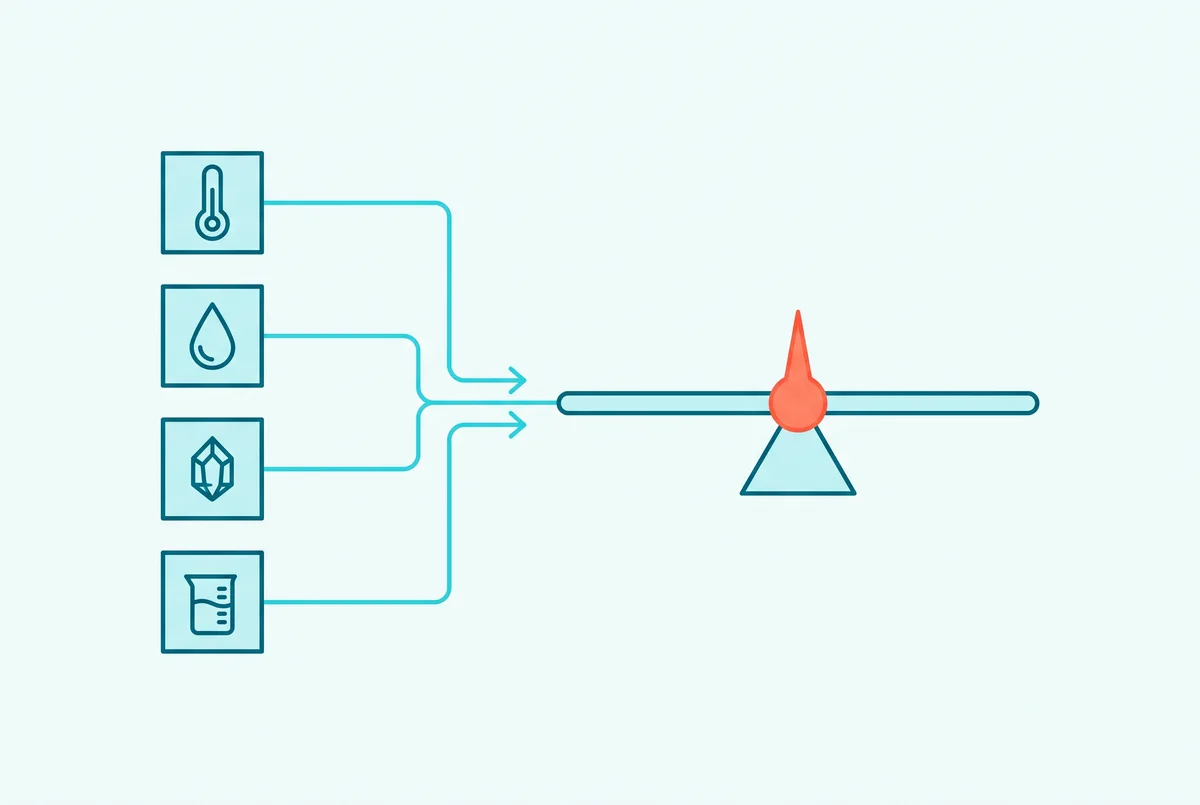
Add the pH, the temperature factor, the calcium-hardness factor, and the carbonate-alkalinity factor, then subtract 12.1 (12.2 above 1,000 ppm total dissolved solids). Between minus 0.3 and plus 0.3 is balanced water; below that is corrosive and above it is scale-forming. Each factor comes from a fixed lookup or log table.
LSI = pH + temperature factor + calcium hardness factor + carbonate alkalinity factor - 12.1. A value near zero is balanced; negative is corrosive, positive is scale-forming.
The formula, worked
Common slip Reading the wrong row off the factor table, or forgetting the 12.1 constant. A result near plus 2 or minus 2 almost always means a factor was misread, not that the water is that far off.
Where this shows up
The saturation index is the capstone: it pulls in pH, temperature, calcium hardness, and alkalinity at once, and the carbonate-alkalinity factor needs the cyanuric-acid correction first. The pool chemistry calculator computes the full index; the practice test drills the water-balance knowledge behind it.
Pool chemistry calculator Knowledge practice test All pool-math domains
Problem set: 6 worked problems
Each problem is original, authored from the underlying non-copyrightable relationship, with the full worked solution and the exact slip that produces each wrong answer. Work the problem before opening the solution. For a timed, randomized run with a per-topic score, use the free knowledge practice test.
Watch for The saturation index is arithmetic once the factors are read correctly. The two failure modes are reading the wrong row off a factor table and forgetting to subtract the constant. Remember the constant is 12.1 at or below 1,000 ppm total dissolved solids and 12.2 above it, and the balanced band is only minus 0.3 to plus 0.3.
-
pH 7.5, temperature factor 0.7, calcium factor 1.9, alkalinity factor 2.0, total dissolved solids below 1,000 ppm. What is the LSI and the verdict?
- A +0.6, scale-forming
- B -0.6, corrosive
- C 12.1, calculation error
- D 0.0, balanced water
Show the worked solution
Correct answer: D. 0.0, balanced water
LSI = pH + TF + CF + AF - 12.1 = 7.5 + 0.7 + 1.9 + 2.0 - 12.1. The four factors sum to 12.1, and 12.1 - 12.1 = 0.0, balanced (inside the minus 0.3 to plus 0.3 band). Forgetting to subtract the 12.1 constant leaves 12.1, an impossible index and the sign you dropped the last step.
Source: Public Langelier relationship: LSI = pH + temperature factor + calcium factor + alkalinity factor - constant (12.1 at TDS at or below 1,000 ppm)
-
pH 7.8, temperature factor 0.7, calcium factor 2.1, alkalinity factor 2.5, TDS below 1,000 ppm. What is the LSI and the verdict?
- A 0.0, balanced
- B +0.5, balanced
- C -1.0, corrosive
- D +1.0, scale-forming
Show the worked solution
Correct answer: D. +1.0, scale-forming
Sum = 7.8 + 0.7 + 2.1 + 2.5 = 13.1; minus 12.1 = +1.0. Anything above +0.3 is scale-forming, so this water will deposit scale. Note that +0.5 is also scale-forming, not balanced: the balanced band ends at +0.3.
Source: Public Langelier relationship: LSI = pH + factors - 12.1; balanced band minus 0.3 to plus 0.3
-
pH 7.2, temperature factor 0.6, calcium factor 1.6, alkalinity factor 2.0, TDS below 1,000 ppm. What is the LSI and the verdict?
- A +0.7, scale-forming
- B -0.1, balanced
- C 0.0, balanced
- D -0.7, corrosive
Show the worked solution
Correct answer: D. -0.7, corrosive
Sum = 7.2 + 0.6 + 1.6 + 2.0 = 11.4; minus 12.1 = -0.7. Below minus 0.3 the water is corrosive and will etch plaster and attack metal, so raise pH, alkalinity, or hardness. Dropping the minus sign flips it to a wrong scale-forming reading.
Source: Public Langelier relationship: LSI = pH + factors - 12.1; below minus 0.3 is corrosive
-
Calcium hardness is 400 ppm. Using the calcium factor CF = log10(hardness) - 0.4, what is the calcium factor?
- A 2.6
- B 3.0
- C 1.8
- D 2.2
Show the worked solution
Correct answer: D. 2.2
log10(400) = 2.60, and 2.60 - 0.4 = 2.2. Forgetting to subtract the 0.4 gives 2.6, the most common calcium-factor slip. The factor grows slowly because it is a logarithm, so doubling the hardness does not double the factor.
Source: Public Langelier calcium-hardness factor: CF = log10(calcium hardness as CaCO3) - 0.4
-
pH 7.6, temperature factor 0.7, calcium factor 1.85, alkalinity factor 2.30, TDS 1,500 ppm (above 1,000). What is the LSI?
- A -0.25, corrosive
- B 0.0, balanced
- C +0.35, scale-forming
- D +0.25, balanced
Show the worked solution
Correct answer: D. +0.25, balanced
Above 1,000 ppm TDS the constant is 12.2, not 12.1. Sum = 7.6 + 0.7 + 1.85 + 2.30 = 12.45; minus 12.2 = +0.25, balanced. Using 12.1 out of habit gives +0.35 and would wrongly flag the water as scale-forming.
Source: Public Langelier relationship: constant is 12.2 above 1,000 ppm total dissolved solids, 12.1 at or below
-
Total alkalinity 120 ppm, cyanuric acid 50 ppm, pH 7.5 (cyanurate factor 0.32). What carbonate alkalinity should you use in the LSI?
- A 120 ppm
- B 70 ppm
- C 136 ppm
- D About 104 ppm
Show the worked solution
Correct answer: D. About 104 ppm
Cyanurate alkalinity = cyanuric acid x pH factor = 50 x 0.32 = 16 ppm. Carbonate alkalinity = total alkalinity minus cyanurate = 120 - 16 = 104 ppm. Using the full 120 ppm overstates the alkalinity factor and pushes the LSI too far toward scale-forming; subtracting the whole 50 ppm instead of the corrected 16 gives 70 ppm.
Source: Public cyanurate-alkalinity correction: carbonate alkalinity = total alkalinity - (cyanuric acid x pH-dependent factor)
Drill the whole exam
Original multiple-choice questions and worked pool-math, free and ungated. No signup; your progress stays on your device.