
Home / Pool chemistry calculator
Free tool - no signup - runs in your browser
Pool chemistry calculator
What is the Langelier Saturation Index?
The Langelier Saturation Index (LSI) is one number that tells you whether pool water is corrosive, balanced, or scale-forming. It sums a pH term, a temperature factor, a calcium-hardness factor, and a carbonate-alkalinity factor, then subtracts a total-dissolved-solids constant. A value near zero is balanced; below minus 0.3 corrodes surfaces and metal, above plus 0.3 forms scale.
Water balance (Langelier Saturation Index)
Chemical dosing (raise a reading)
Study and planning tool only. Confirm every product strength on its own label and add chemicals exactly per the manufacturer's directions, always adding chemical to water, never water to chemical, and never mixing products. This calculator does not certify anyone and is a supplement to, not a substitute for, the required instructor-led pool-operator course.
How the Langelier Saturation Index is calculated

The index uses the formula LSI = pH + TF + CF + AF - TDSC. Each factor comes from a fixed public
table or a logarithm of one of your readings. The calculator applies these exact rules:
- Calcium-hardness factor (CF): CF = log10(calcium hardness in ppm as CaCO3) - 0.4.
- Alkalinity factor (AF): AF = log10(carbonate alkalinity in ppm as CaCO3).
- Carbonate alkalinity: total alkalinity minus a cyanurate correction (cyanuric acid times a factor that rises with pH), so stabilizer does not inflate the balance. Leave cyanuric acid at 0 to skip it.
- Total-dissolved-solids constant (TDSC): 12.1 for total dissolved solids at or below 1000 ppm, 12.2 above it.
Temperature factor table
| Water temperature (degrees F), at or above | Factor |
|---|---|
| 32 | 0.0 |
| 37 | 0.1 |
| 46 | 0.2 |
| 53 | 0.3 |
| 60 | 0.4 |
| 66 | 0.5 |
| 76 | 0.6 |
| 84 | 0.7 |
| 94 | 0.8 |
| 105 | 0.9 |
| 128 | 1.0 |
Interpretation: LSI LSI below -0.3 means corrosive water, LSI from -0.3 to +0.3 is balanced, and LSI above +0.3 is scale-forming. Some references use a wider balanced band of plus or minus 0.5. This tool uses the tighter plus or minus 0.3 common in pool operation.
How chemical dosing is calculated
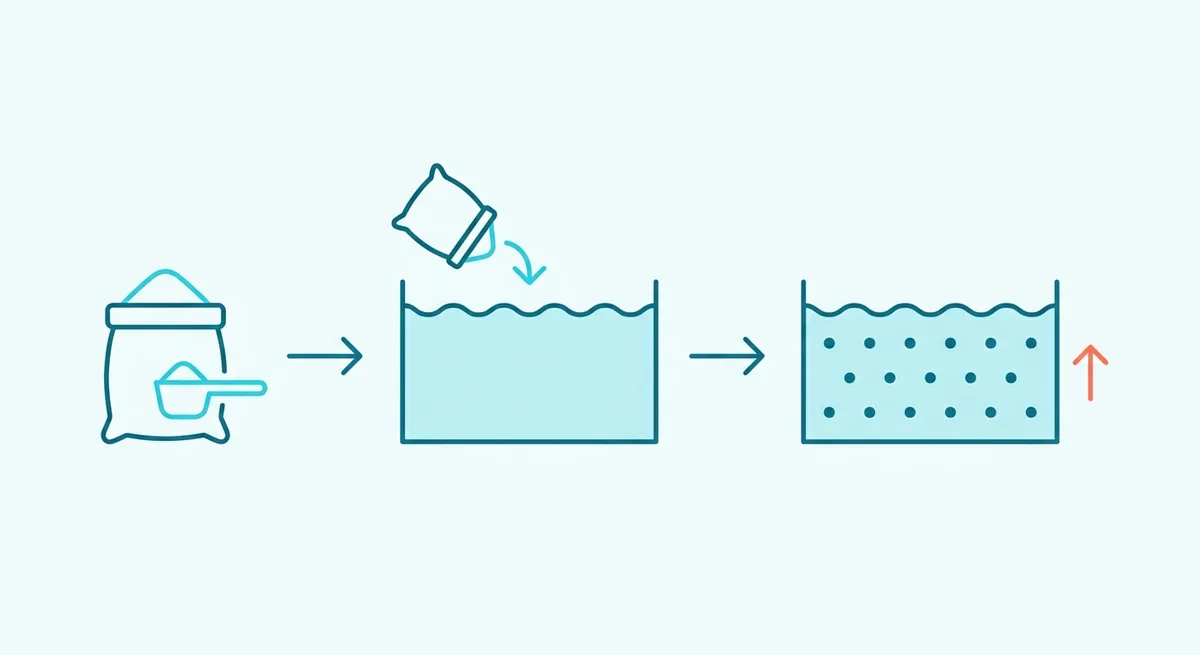
Dosing uses the standard parts-per-million-to-weight relationship:
pounds of pure chemical = pool volume (gal) x ppm change x 8.34 / 1,000,000, then multiplies by a product factor that accounts for
the product's strength. The number 8.34 is the weight in pounds of one US gallon of water. The
products and factors used:
| Raises | Product | Factor | Factor basis |
|---|---|---|---|
| Free chlorine | Calcium hypochlorite (cal-hypo), 65% available chlorine | 1.538 | 100 / 65 |
| Free chlorine | Sodium dichlor, 56% available chlorine | 1.786 | 100 / 56 |
| Free chlorine | Trichlor, 90% available chlorine | 1.111 | 100 / 90 |
| Free chlorine | Lithium hypochlorite, 35% available chlorine | 2.857 | 100 / 35 |
| Total alkalinity | Sodium bicarbonate | 1.679 | molar mass 84.0 / equivalent weight of CaCO3 50.04 |
| Calcium hardness | Calcium chloride (anhydrous) | 1.109 | molar mass 110.98 / equivalent 100.09 as CaCO3 |
| Calcium hardness | Calcium chloride dihydrate | 1.469 | molar mass 147.01 / equivalent 100.09 as CaCO3 |
| Cyanuric acid | Cyanuric acid (stabilizer) | 1 | added directly, measured as cyanuric acid |
Available-chlorine percentages are standard product strengths (verify against the actual label). Molar masses are fixed chemical facts. These products raise a reading; lowering a reading needs acid or dilution.
Pool chemistry calculator FAQ
What is the Langelier Saturation Index?
The Langelier Saturation Index (LSI) is one number that tells you whether pool water is corrosive, balanced, or scale-forming. It sums a pH term, a temperature factor, a calcium-hardness factor, and a carbonate-alkalinity factor, then subtracts a total-dissolved-solids constant. A value near zero is balanced.
Is this pool chemistry calculator free?
Yes. Both the water-balance and the dosing calculator run entirely in your browser with no signup, no email, and no paywall. Your exact readings stay on your device; when you calculate we receive only anonymous aggregate statistics, such as a banded pH range and the balance verdict, with no identifier. See our privacy policy for details.
How accurate is the dosing calculation?
It applies the standard parts-per-million-to-weight formula using published product strengths, so it is accurate for study and planning. Always confirm the actual strength on your product label and follow the manufacturer's directions, because available-chlorine percentages vary between products.
Can this calculator lower my pH or alkalinity?
No. The dosing engine covers products that raise a reading, such as chlorine, sodium bicarbonate, calcium chloride, and cyanuric acid. Lowering pH or alkalinity needs acid or dilution, which depends on a titration and is outside this tool. Use it to plan increases and to check your worked pool-math answers.