
Home / Pool math / Percent-available-chlorine adjustment
Advanced operator drill · free · no signup
Percent-available-chlorine adjustment
How do you adjust a chlorine dose for product strength?
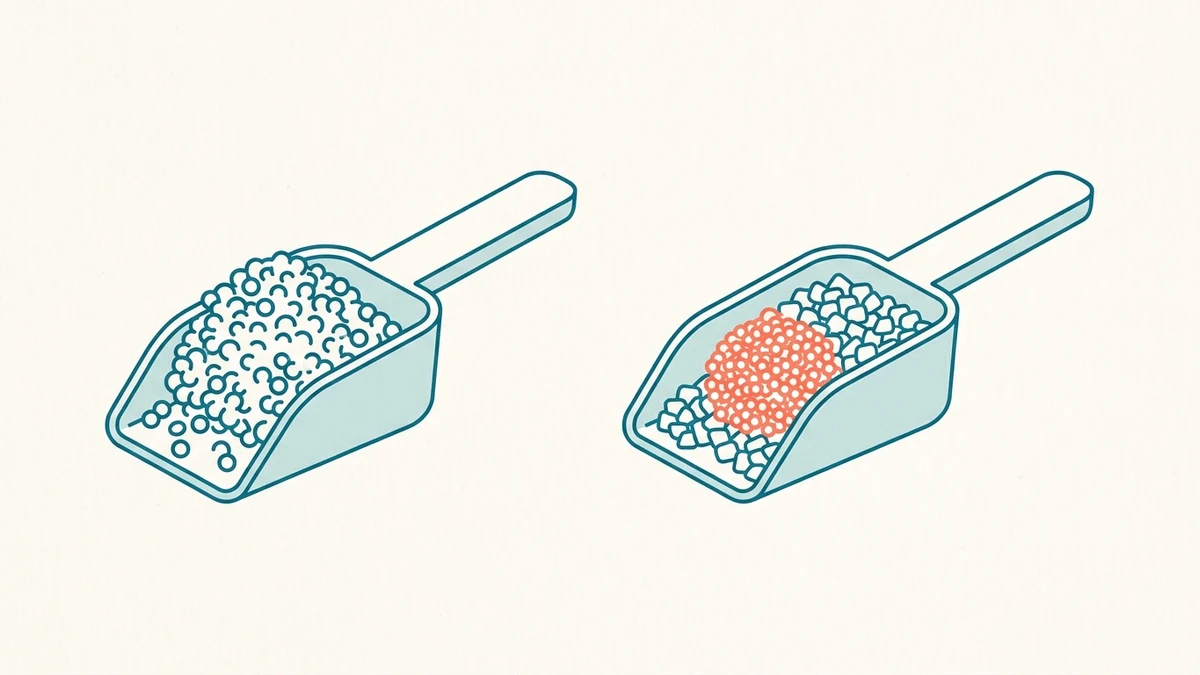
Divide the pounds of pure chlorine you need by the product's available-chlorine fraction. Calcium hypochlorite at 65 percent means dividing by 0.65, so you need about 1.54 times the pure weight. A weaker product always needs more weight, so you divide by a fraction below one, never multiply.
Product weight = pure weight / available-chlorine fraction. Cal-hypo is about 65% available chlorine, sodium dichlor 56%, trichlor 90%, lithium hypochlorite 35%. Because the product is weaker than pure, you always need MORE of it, so you divide by a number less than one.
The formula, worked
Common slip Multiplying by the percent instead of dividing. Multiplying 4.17 by 0.65 gives 2.71 lb, far too little, because it treats the weaker product as if it were stronger than pure. A partial-strength product always needs more weight, never less. Verify the exact percent against the product label.
Where this shows up
This adjustment is the second half of chemical dosing, applied after the ppm-to-weight conversion gives the pure weight. The pool chemistry calculator dosing engine carries the same product factors from tool-data.json.
Pool chemistry calculator Knowledge practice test All pool-math domains
Problem set: 6 worked problems
Each problem is original, authored from the underlying non-copyrightable relationship, with the full worked solution and the exact slip that produces each wrong answer. Work the problem before opening the solution. For a timed, randomized run with a per-topic score, use the free knowledge practice test.
Watch for A partial-strength product always needs MORE weight than the pure chemical, so you divide the pure weight by the available fraction. Multiplying by the percent instead of dividing is the defining error: it under-doses and treats a weak product as stronger than pure. Verify each product percent against the actual label.
-
You need 4.17 lb of pure chlorine. How much cal-hypo (65% available chlorine) does that take?
- A 2.71 lb
- B 11.9 lb
- C 4.17 lb
- D 6.42 lb
Show the worked solution
Correct answer: D. 6.42 lb
Product weight = pure weight / fraction = 4.17 / 0.65 = 6.42 lb. Multiplying by 0.65 gives 2.71 lb, which is backwards because a weaker product needs more weight, not less; leaving it at 4.17 skips the adjustment entirely.
Source: Public relationship: product weight = pure weight / available-chlorine fraction
-
You need 2.0 lb of pure chlorine. How much trichlor (90% available chlorine) does that take?
- A 1.80 lb
- B 5.71 lb
- C 2.00 lb
- D 2.22 lb
Show the worked solution
Correct answer: D. 2.22 lb
2.0 / 0.90 = 2.22 lb. Because trichlor is nearly pure at 90 percent, the product weight is only a little above the pure weight. Multiplying by 0.90 gives 1.80 lb and under-doses.
Source: Public relationship: product weight = pure weight / available-chlorine fraction
-
You need 3.0 lb of pure chlorine. How much lithium hypochlorite (35% available chlorine) does that take?
- A 1.05 lb
- B 3.00 lb
- C 4.62 lb
- D 8.57 lb
Show the worked solution
Correct answer: D. 8.57 lb
3.0 / 0.35 = 8.57 lb. Lithium hypochlorite is weak, so it takes almost three times its pure weight. Multiplying by 0.35 gives 1.05 lb; using cal-hypo's 65 percent by mistake gives 4.62 lb.
Source: Public relationship: product weight = pure weight / available-chlorine fraction
-
For the same amount of pure chlorine, which product requires the most product by weight?
- A Cal-hypo, 65% available chlorine
- B Sodium dichlor, 56% available chlorine
- C Trichlor, 90% available chlorine
- D Lithium hypochlorite, 35% available chlorine
Show the worked solution
Correct answer: D. Lithium hypochlorite, 35% available chlorine
The lower the available fraction, the smaller the number you divide by, so the more product you need. Lithium hypochlorite at 35 percent has the lowest strength here, so it takes the most weight; trichlor at 90 percent takes the least.
Source: Public relationship: product weight = pure weight / available-chlorine fraction
-
You need 1.5 lb of pure chlorine. How much sodium dichlor (56% available chlorine) does that take?
- A 0.84 lb
- B 2.31 lb
- C 1.50 lb
- D 2.68 lb
Show the worked solution
Correct answer: D. 2.68 lb
1.5 / 0.56 = 2.68 lb. Multiplying by 0.56 gives 0.84 lb and under-doses; using cal-hypo's 65 percent gives 2.31 lb, so match the fraction to the actual product.
Source: Public relationship: product weight = pure weight / available-chlorine fraction
-
You need 5.0 lb of pure chlorine from cal-hypo (65% available chlorine). How many ounces of product is that?
- A About 80 oz
- B About 77 oz
- C About 52 oz
- D About 123 oz
Show the worked solution
Correct answer: D. About 123 oz
Product weight = 5.0 / 0.65 = 7.69 lb; ounces = 7.69 x 16 = 123 oz. Skipping the purity divisor gives 5.0 x 16 = 80 oz; using 10 instead of 16 gives 77 oz.
Source: Public relationship: product weight = pure weight / fraction; 16 oz per lb
Drill the whole exam
Original multiple-choice questions and worked pool-math, free and ungated. No signup; your progress stays on your device.